

Most people approach a bedroom redesign backwards. They collect images, pick a colour, and add furniture until it looks right. The problem is that "looking right" in a photo is not the same as actually feeling restful when you walk in at 10pm.
A Japandi bedroom isn't beautiful because it's minimal. It's minimal because that's what actually helps a room feel restful — the beauty is the byproduct. Every decision in this guide connects back to that idea. If a choice doesn't help you wind down, it doesn't belong in the room. For specific inspiration on this, see our 10 Dark Japandi Living Room Ideas for a Moody Atmospheric Home.
What Japandi Actually Means for a Bedroom (And Why It Works Beyond the Look)
Japandi is a blend of Japanese and Scandinavian design thinking. Both cultures independently developed a deep respect for natural materials, honest craftsmanship, and rooms that don't overstimulate.
In a bedroom, this matters more than in any other room. The bedroom has one job: help you rest.
Wabi-Sabi Meets Hygge — Where the Two Traditions Meet in One Room

Japanese wabi-sabi contributes restraint and imperfection. A slightly uneven ceramic, a linen weave that isn't perfectly smooth, a piece of wood with visible grain — these details signal that the room is handmade and human, not manufactured. For specific inspiration on this, see our 10 Japandi Living Room Color Schemes That Designers Actually Use.
Scandinavian hygge contributes warmth and physical comfort. Soft textures, warm light, and materials that feel good to touch. Together, they make a room that is quiet without being cold.
How Japandi Differs From Minimalism and Zen — and Why That Distinction Changes What You Buy

Plain minimalism can be deliberately austere. White walls, concrete floors, almost no textiles — it looks clean, but it doesn't feel warm. Zen interiors share that quality, and many Western sleepers find them too bare to feel comfortable in.
Japandi is warm minimalism. The restraint is still there, but warmth is the goal. That warmth shows up in every single material choice — from wood species to bulb temperature to the weight of your duvet.
If you're choosing between two nightstands and one feels colder, that's the wrong one for this style.
Price history tracked · tap to check current price on Amazon
 ✦ All-time low
 Modern & Minimalist Bed
Price history · 16 weeks
 = Price stable
 Beige Accent Chairs Set of 2
Price history · 16 weeks
 ✦ Editor's pick
 Rattan Nightstand with 2 Drawers
Price history · 16 weeks
The Japandi Color Palette — Why Capping at 2–3 Colours Helps Your Brain Wind Down
Colour is visual information. At night, when your brain is trying to slow down, every additional colour is one more signal it has to process.
Capping a Japandi bedroom at two or three colours isn't an aesthetic rule. It's a practical one. Fewer visual signals genuinely support easier winding-down.
The Colours That Belong in a Japandi Bedroom

The working palette: warm white, oat, greige, taupe, clay, soft sage, and charcoal. Apply one tone to walls, one wood species throughout the furniture, and one muted accent in textiles.
For example: warm white walls, natural oak furniture, and a clay linen duvet. That's the full palette. The 10 Japandi living room colour schemes that designers actually use shows how the same restraint works across a whole home.
The Colours That Break the Look — and Why Cool Tones Are the Most Common Mistake

Stark white (think bright optical white) reads as clinical. Cool grey reads as generic. Both colours feel sharp rather than warm under artificial light.
The moment you introduce a cool-toned neutral, the room shifts from Japandi to plain minimalism — and the restfulness goes with it. If a paint sample has any blue or green undertone, it's the wrong one for this style.
Japandi Bedroom Furniture — Real Specs, Right Pieces, and How Much Is Too Much
Japandi furniture is low, solid, and made from natural materials. The goal isn't to fill the room. It's to give a few good pieces room to breathe.
Each piece should be visible from multiple angles. If something is pushed against a wall and barely noticeable, it's either doing nothing or it shouldn't be there.
Bed Frame Height, Wood Species, and the Case for a Simple Slatted Headboard

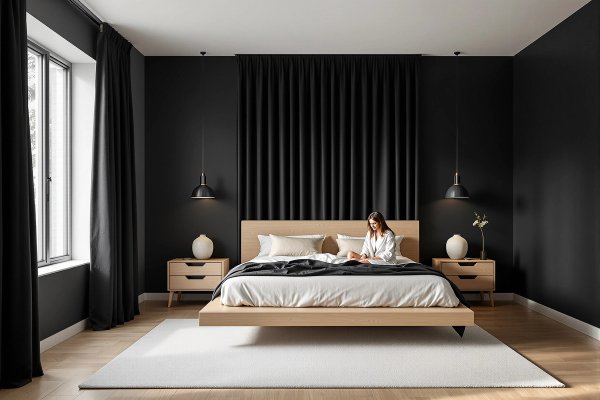
The bed frame should sit between 20cm and 25cm from floor to the top of the mattress. This low profile keeps the visual centre of gravity down. A lower room feels quieter and more settled than one where the furniture rises to mid-chest height.
For wood species: oak is lighter in colour and creates a calmer, airier feel. Walnut is darker and moodier — it suits rooms with charcoal textiles or deeper wall tones. If you want a headboard, a simple slatted design in the same wood as the frame is all you need. Ornate or upholstered headboards introduce visual weight that this style doesn't support.
Nightstands, Low Storage, and Why Deliberate Asymmetry Beats Perfect Symmetry

Two matching nightstands at the same height reads as generic hotel furniture. Instead, try a slightly different height or a marginally different style on each side. This is a direct application of wabi-sabi — small imperfection signals intention rather than a furniture package deal.
Low storage always outperforms tall storage in this style. A low oak dresser at 60–70cm height keeps sightlines open. Floating shelves do the same. Tall wardrobes are acceptable only if flush-fronted and in a matching wood tone.
The 3–4 Piece Rule — How Much Furniture a Japandi Bedroom Can Actually Hold

A Japandi bedroom holds a bed, two nightstands, and one storage piece — that's four pieces. Adding a fifth pushes most bedrooms into "furnished" rather than "breathing."
Each piece needs real space around it. If you have to angle yourself sideways to move past a dresser, it's too tight. The room should feel navigable without thinking about it.
The 30% Visible Floor Rule — The Layout Principle That Changes How Every Room Feels

If furniture, rugs, and objects cover more than roughly 70% of the floor, the room reads as cluttered — regardless of the style.
Keeping at least 30% of the floor completely visible is the single most practical layout decision you can make in a small or mid-sized bedroom. It's the reason a Japandi room with four pieces of furniture can feel more open than a room with six.
Pull your rug in from the walls. Leave floor space at the sides of the bed. Don't push every piece of furniture against a wall to "make room" — that counter-intuitively makes the room feel more enclosed.
Japandi Bedding — How to Layer Linen for Warmth Without Breaking the Palette
Linen is the defining fabric in a Japandi bedroom. It breathes well, sleeps cool in summer and warm in winter, and develops more texture with every wash.
Cotton works as a secondary layer — a cotton fitted sheet under a linen duvet, for instance. But linen should be visible.
Choosing Linen and Building Gentle Colour Contrast Across Layers

Use a lighter fitted sheet — sand, bone, or soft oat — under a slightly deeper duvet cover in clay, warm charcoal, or a deeper oat tone. The contrast is subtle, but it creates visual depth that a perfectly matched "bed in a bag" set never achieves.
Mismatched-but-muted layers look like a considered choice; matched sets look like a shortcut. That contrast is what makes the bed look intentional rather than functional.
Texture Over Pattern — Why Two Pillows Do More Than Eight

A wool throw at the foot of the bed adds warmth and visual weight. In a style where pattern is mostly absent, texture is doing all the decorative work.
Two to three pillows is the maximum for a Japandi bed. A sleeping pillow per person, and one structured linen euro or bolster if you want to add shape. A fortress of decorative cushions breaks the logic entirely — it introduces exactly the kind of visual noise this style works to remove.
Japandi Bedroom Lighting — Why Overhead Light Works Against Rest (and What to Use Instead)
A single ceiling light throws even, flat light across a room. There are no shadows, no depth, and no gradation. That kind of light is useful for getting dressed. It's actively unhelpful for winding down.
The brain reads bright, even overhead light as "daytime." Soft, directional, lower-level light reads as evening. That difference matters in a room designed around rest.
Building a Layered Lighting Plan: Floor Lamp, Pendant, and Nightstand Height

Use two to three light sources. A floor lamp with a paper or rattan shade in one corner creates warmth and shadow. A low pendant over a bedside table works if the ceiling height allows it.
Nightstand lamps should sit at roughly seated eye level — approximately 120–140cm from the floor — so the light falls where you're actually reading. A lamp that's too high throws light down onto the page instead of across it.
2700K and Under — The One Bulb Spec Worth Shopping By

Colour temperature is measured in Kelvin. 6500K is cool daylight — the kind used in offices. 2700K is the warm amber of a traditional incandescent bulb. For pre-sleep wind-down, design authorities like Architectural Digest consistently point to warm bulbs as a practical sleep-environment decision, not just an aesthetic one.
Apply the 2700K rule to every source in the room without exception. One cool bulb in an otherwise warm room is enough to undo the rest of the layering.
Texture Is Doing More Work Than Colour in a Japandi Bedroom — Here Is the Full Material List

In most design styles, colour and pattern carry the visual interest. In Japandi, both are deliberately suppressed. That means texture has to do all the sensory work — and choosing the right materials is the single most important styling skill in this style.
Most beginners miss this. They strip back colour correctly, then wonder why the room feels flat. The answer is almost always that the textures are too uniform.
The material vocabulary for a Japandi bedroom:
- Linen — for bedding, curtains, and cushion covers. Matte, slightly uneven surface.
- Raw or matte-finish oak — for bed frames, shelves, and side tables. Not lacquered.
- Walnut — for darker rooms. Deep warm brown, also matte-finish.
- Rattan — for lampshades, small trays, or storage baskets. Adds organic line work.
- Unglazed ceramic — for vessels and candle holders. A matte, slightly rough surface reads as handmade.
- Washi paper — for lamp shades and wall accents. Translucent, warm, and very Japanese in character.
- Natural stone — small pieces on shelves or as a tray surface. Travertine or honed slate work well.
- Wool — for throws. The heaviest, warmest texture in the room.
Each material has a different surface quality. That variation is the point.
Styling Decor in a Japandi Bedroom — The Discipline of One to Two Objects Per Surface
A nightstand should hold one or two objects. A shelf should hold one or two objects. This isn't about emptiness — it's about making sure every object can justify its place on its own terms.
If you need a group of things to make a surface look styled, none of the individual things are strong enough. Choose better objects, not more of them.
What Earns a Spot on a Japandi Nightstand or Shelf

A single ceramic vessel in an earthy, unglazed finish. One plant in a plain ceramic pot. A wooden candle holder. A piece of woven or textural wall art. Each of these works alone because it has visual weight, material interest, and a reason to exist.
Clusters of small similar objects — three matching candles, five small stones, a row of identical pots — break this logic. They read as decoration for decoration's sake, which is precisely what this style avoids.
Rotate, Don't Accumulate — How to Keep a Japandi Room Feeling Fresh Each Season

Instead of adding new decor each season, swap what's already there. A plant in spring becomes a small bunch of dried pampas grass in winter. A cotton throw at the foot of the bed becomes a heavier wool one.
The room changes without growing. This is the only way to keep a Japandi bedroom from slowly drifting into clutter over two or three years of seasonal "refresh" purchases.
Small Japandi Bedroom and Renter-Friendly Adaptations That Actually Work

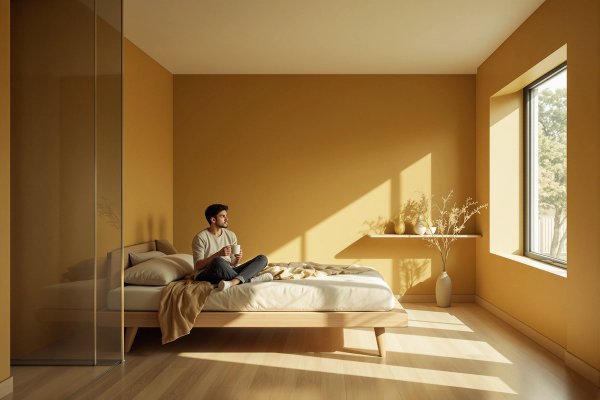
Low furniture makes a small room feel larger. A platform bed at 20–25cm sits below the natural sightline, which makes the ceiling feel higher and the walls feel further apart. A raised bedframe on legs has the opposite effect — it draws the eye up and makes the space feel more enclosed.
The 30% floor rule matters even more in a small room. If you only have space for a bed and one nightstand, that's the room.
For renters, the same principles apply — just through different methods. Use freestanding floor lamps instead of hardwired fixtures. Hang linen curtains on a tension rod instead of drilling brackets. Use removable wallpaper in a warm neutral texture instead of paint, or hang a large woven wall piece as a focal point. For more ideas on applying minimal bedroom principles without permanent changes, 12 small Japandi living room ideas that make any space feel bigger covers the same logic in a shared living space.
Japandi Bedroom on a Budget — Three Spending Tiers From $150 to $1,500+

You don't need to buy everything at once. Japandi rooms are built gradually — which is actually truer to the style's philosophy than a one-weekend overhaul.
Start with what you sleep on and what you see first, then work outward.
Entry Tier: $150–$300
At this level, prioritise: a linen or linen-look duvet cover and fitted sheet set ($60–$120), a natural jute or cotton loop rug ($40–$80), a paper pendant light or floor lamp with a rattan shade ($30–$60), two to three matte ceramic objects ($15–$30 each), and warm 2700K bulbs for every existing fixture ($5–$15). These changes alone move a room noticeably toward the right direction.
Mid Tier: Around $800
Add a low platform bed frame in oak or oak-effect finish ($300–$450), a light oak or ash side table ($80–$150), and upgraded linen bedding with a wool throw ($120–$200). Replace at least one light source with a proper layered option.
Full-Room Tier: $1,500 and Up
A solid oak or walnut platform bed frame ($600–$1,200), quality stonewashed linen throughout ($200–$350), a full three-source lighting plan with washi or rattan shades, and two to three handthrown ceramic pieces ($40–$90 each). At this tier, every material is the real thing — and the room shows it.
Troubleshooting: Why Your Japandi Bedroom Still Feels Off Even After Following the Rules
If you've followed the general guidance and the room still doesn't feel right, the problem is almost always one of three things.
The first is cool-toned neutrals. A grey with blue undertones, or a white that reads bright rather than warm, will keep the room feeling sharp regardless of what else you do. Hold paint swatches against your wood furniture in evening light — if the wall looks cooler than the wood, swap it.
The second is single-source lighting. One overhead light, even on a dimmer, cannot create the layered warmth this style needs. Adding one floor lamp with a warm bulb will change the room faster than almost any other single change.
The third is surfaces that are either too bare or too full. Too bare reads as cold — an empty nightstand with no object at all has no warmth to offer. Too full breaks the one-to-two-object logic and the room starts to feel like it's accumulating rather than considered. One ceramic vessel on a nightstand is enough.
Frequently Asked Questions
What colours work in a Japandi bedroom?
Stick to warm neutrals: warm white, oat, greige, taupe, clay, soft sage, and charcoal. Cap the palette at two to three colours — one for walls, one wood tone throughout the furniture, and one muted accent in textiles. Avoid cool greys and stark whites, which push the room toward generic minimalism rather than the warm restraint Japandi is built on.
What kind of bed frame is best for a Japandi bedroom?
A low platform-style frame in solid oak or walnut, sitting 20–25cm from floor to the top of the mattress. No ornate headboard — either no headboard at all, or a simple slatted wood panel in the same species as the frame. The low profile is functional: it keeps the visual weight of the room down and makes even a small bedroom feel more open.
Can you do Japandi on a small budget?
Yes, starting with linen bedding, warm-temperature bulbs, and one or two matte ceramic objects ($150–$300 total) will move a room meaningfully toward this style. Japandi is not about expensive pieces — it's about the right materials and real restraint. A $60 linen duvet cover and a $5 bulb swap will do more than a $400 decorative accessory in the wrong material.
A Japandi bedroom isn't something you finish in a weekend. It's a set of decisions — about materials, light, objects, and space — that compound over time into a room that actually helps you rest.
Comments