

You've saved 40 Japandi kitchen pins. You still don't know which pull to buy or what color to paint the doors. That's because most articles show you the finished room and skip the decision that made it work. This one does the opposite. Every section starts with one cabinet detail — a specific material, finish, or measurement — and then builds a complete kitchen around it.
These are the japandi kitchen cabinet ideas that show up again and again in well-executed kitchens, not because they're trendy, but because each one solves a real problem. Japandi kitchen cabinet design sits on a wide spectrum — from Muji-style minimal to Nordic warmth — and the 12 ideas here cover every point on it. Whatever kitchen cabinet japandi style you lean toward, the decisions below give you a solid starting point. For the complete picture, explore our full guide: The Ultimate Japandi Bedroom Guide: Ideas Decor and Styling Tips.
1. Grain-Matched Oak Slab Doors That Read as One Piece of Furniture

Rift-sawn white oak slab doors are flat, with no frame or profile. The detail that separates a considered kitchen from a flat-pack one is grain matching: ordering all the fronts from the same panel stock, so the grain runs continuously across the whole run. Gaps between doors should be no wider than 3mm. The finish is a matte oil, not lacquer.
Mismatched grain is the single thing that makes wood cabinet doors look like they came from a box. When the grain aligns, a whole run of japandi kitchen cabinet doors reads as one handmade piece of furniture, not a row of separate boxes.
This is a planning detail, not a product choice, and it is the japandi kitchen cabinet detail most often skipped. It costs little extra when you specify it at order time, and it is impossible to fix afterward. The rule is simple: order every front in one batch, from the same panel, at the same time. You'll find even more ideas in 10 Dark Japandi Bedroom Ideas for a Moody and Restful Atmosphere.
Complete the Look
- Hardware: slim bronze edge tabs
- Style: modern Japandi
- Walls: warm white plaster
- Countertop and backsplash: honed limestone slab, with a deep green-gray handmade tile backsplash
- Island: smoked-oak island with a limestone top
- Floor: polished concrete
- Lighting: one long linear linen pendant
2. Narrow-Rail Shaker in Warm White

Standard shaker doors have rails about 7cm wide. Reducing those rails to 2.5cm changes the whole character of the door. The panel becomes larger, the frame almost disappears, and the door shifts from country cottage to quiet modern. The color matters just as much as the rail width.
Choose a warm white with a yellow or cream undertone, not a blue-white. Blue-white reads clinical under most kitchen lighting. A warm white reads like a white cabinet japandi kitchen that has been there for years.
The rule for this door style is no glass inserts and no beadboard — both push it back toward farmhouse and undo the effect. Keep the door flat and the color warm, and a 2.5cm shaker will sit naturally in any Japandi space.
Complete the Look
- Hardware: 96mm unlacquered brass bar pulls
- Style: Nordic Japandi
- Walls: soft oatmeal
- Countertop and backsplash: white oak butcher block, with handmade white tile stacked vertically
- Island: white oak island with narrow-rail shaker panels
- Floor: dark walnut-stained wide planks
- Lighting: two ceramic dome pendants
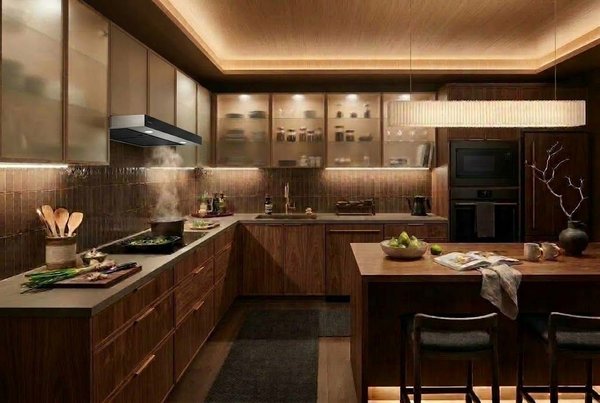
3. Reeded-Glass Wall Cabinets With Warm Inner Light

Reeded glass has a ribbed texture that blurs anything behind it. Set it into slim 2cm oak frames, and the wall cabinet becomes something decorative rather than purely functional. The japandi kitchen glass cabinet works because you don't need to keep the shelves tidy — the glass hides what's inside.
The lighting detail is what makes this a japandi kitchen wall cabinet worth copying. A 2700K LED strip inside the cabinet turns the blurred shapes of stacked ceramics into a soft, warm glow. Add an under-cabinet LED strip at the same color temperature for continuity — that matching japandi kitchen cabinet light is what ties the upper and lower runs together. The glass hides the clutter; the inner light turns it into something worth looking at.
The rule: shelves inside reeded-glass cabinets hold ceramics and glassware only. No packaging, no jars with labels. The blur softens, but it doesn't erase.
Complete the Look
- Hardware: small oak knobs
- Lower cabinets: deep slate blue
- Style: modern Japandi
- Walls: warm greige
- Countertop and backsplash: beige terrazzo, with matching terrazzo for the backsplash
- Island: slim oak console-style island
- Floor: oak herringbone
- Lighting: two clear glass globe pendants
Price history tracked · tap to check current price on Amazon
 = Price stable
50 Pack 1/2" Overlay 3D Soft Close Concealed Hinge for Face Frame Door
Price history · 16 weeks
 ↑ Price rising
10 Pack 3 inch Brushed Gold Kitchen Cabinet Handles
↑ At peak — price may drop
Price history · 16 weeks
 ✦ Editor's pick
Decorative Frosted Film, for kitchen windows
Price history · 16 weeks
4. Integrated Finger-Pull Edges for a Handleless Run

A 20mm routed finger-pull along the top edge of lower drawers and the bottom edge of upper cabinets removes all visible hardware from the kitchen. There is nothing to catch the eye and nothing to snag clothing. The alternative is a recessed channel profile, which achieves the same result with a slightly crisper shadow line.
This is the most minimal of all kitchen cabinet handles japandi approaches, and the cleanest japandi kitchen cabinet handle there is: no handle at all. The shadow line becomes the handle. A handleless run reads as one quiet, unbroken surface — the closest a kitchen can get to looking like a wall.
The rule is absolute: use the finger-pull on every drawer and door, or none. Mixing this detail with bar pulls or knobs on the same run breaks the effect completely. This is the defining choice for a muji japandi kitchen cabinet or japandi minimalist kitchen cabinet look.
Complete the Look
- Cabinets: matte clay-taupe lacquer
- Style: Muji-style minimalist
- Walls: chalk limewash
- Countertop and backsplash: microcement, carried up the wall as the backsplash
- Island: microcement block island
- Floor: smoked oak planks
- Lighting: recessed downlights plus one ceramic pendant
5. Short Wooden Pulls, Sized and Placed by Rule

Walnut or oak pulls between 96mm and 160mm long are one of the most repeated japandi kitchen cabinet hardware choices in well-executed kitchens. The sizing rule is that a pull should be about one-third of the drawer width. A 480mm drawer takes a 160mm pull. A 300mm drawer takes a 96–100mm pull.
Placement is just as important as size. On drawers, center the pull horizontally. On doors, mount it vertically, 7–10cm from the opening edge. Line up every pull across the whole run on one continuous horizontal height, and the hardware disappears into the rhythm of the kitchen.
These are the japandi kitchen cabinet pulls that feel warm in the hand and quiet on the eye. The rule is firm: never use a pull longer than half the drawer width. Oversized pulls are the most common hardware mistake in this style.
Complete the Look
- Cabinets: bone slab fronts
- Style: Nordic Japandi
- Walls: pale clay
- Countertop and backsplash: honed white marble, with a marble slab backsplash
- Island: walnut
- Floor: oak parquet
- Lighting: walnut-and-linen pendants
6. Ceramic Knobs on Doors, Pulls on Drawers

Handmade matte ceramic knobs at 25–30mm diameter suit doors. Pulls suit drawers. Using both in the same kitchen works when the material is identical — same clay body, same glaze, same maker if possible. This is the most tactile of all japandi kitchen cabinet knobs approaches.
Mixing materials is what looks messy, not mixing shapes — a ceramic knob and a ceramic pull in the same glaze are always quieter than two different materials. One glaze color for every piece of hardware in the kitchen is the rule.
The effect is handmade and grounded. It references the Japanese mingei tradition of beautiful everyday objects without referencing it literally.
Complete the Look
- Cabinets: light ash slab
- Style: modern Japandi
- Walls: sand plaster
- Countertop and backsplash: flecked quartz, with a deep indigo square matte ceramic tile laid in a straight grid
- Island: ash island with an open shelf at the end
- Floor: cream hexagon tile
- Lighting: a cluster of three small ceramic pendants
7. Warm-White Uppers Over Oak Lowers

Two-tone cabinetry is one of the most repeated japandi kitchen cabinet color combinations, but the order matters. Warm-white uppers over oak lowers always. Never the reverse. Dark on top makes a kitchen feel top-heavy and closed; light on top keeps the room feeling tall.
The split happens exactly at the countertop line. Not mid-door, not halfway up the wall. Start the uppers 45–50cm above the counter so the oak run reads as a solid base. The counter is the visual dividing line, and the color change should land right there.
Oak for the lowers brings warmth and grain. The warm-white uppers keep the room open. The two tones work because they echo the natural world — pale sky above, dark earth below.
Complete the Look
- Hardware: slim oak pulls
- Style: Nordic Japandi
- Walls: bone
- Countertop and backsplash: travertine, with a travertine slab backsplash
- Island: oak with a travertine top
- Floor: dark slate tile
- Lighting: a pair of linen drum pendants
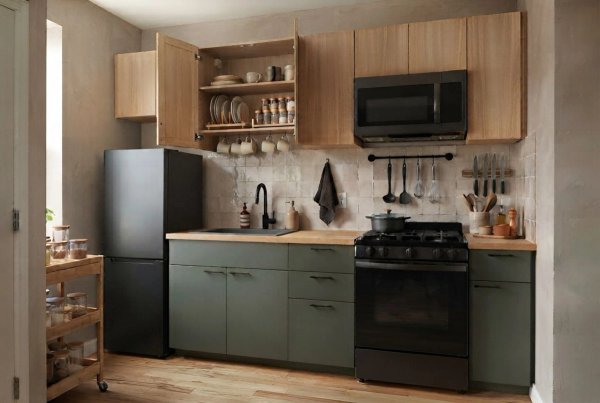
8. Muted Sage Cabinets With Oak Accents

For anyone exploring kitchen cabinet color ideas japandi beyond white and wood, sage is the most reliable color choice. The caveat is the tone. Sage with gray in it looks like a natural material in daylight and holds its depth in the evening. Sage with blue or yellow in it reads like a paint chip from a hardware store.
Specify a matte or eggshell finish on slab or narrow-rail doors, and limit the oak accents to two or three pieces — an island top, the pulls, and perhaps open stools. Pick a sage with gray in it — a clean green looks like a decorating decision; a grayed sage looks like it has always been there. This is the distinction between a japandi green kitchen cabinet and a kitchen that just happens to be green.
The rule: sage on the lowers, or on all cabinets. Sage uppers over white lowers reverses the visual weight and makes the room feel heavy at the ceiling.
Complete the Look
- Hardware: short oak pulls on drawers, small oak knobs on doors
- Style: Nordic Japandi
- Walls: cream limewash
- Countertop and backsplash: soapstone, with cream zellige tile
- Island: sage with a thick oak top, two oak stools
- Floor: terracotta tile
- Lighting: two ceramic pendants at 2700K
9. Charcoal or Smoked-Oak Lower Cabinets

Smoked oak keeps visible grain but deepens the tone to near-black. A matte warm charcoal achieves a similar result without the wood texture. Either one, used on the lower cabinets only, anchors a light kitchen and hides the scuffs that lower cabinets always collect. This is the japandi kitchen dark cabinet approach that works in real daily-use kitchens.
The pairing rule is non-negotiable: the counter must be light. A dark counter on dark lower cabinets merges everything into one flat mass. A light counter — honed white quartzite works well — gives the eye a clear horizontal line to rest on.
Keep the uppers and the wall above light, and dark lowers will read as grounded rather than heavy. Leave at least 60cm of light wall or pale uppers above the dark run so the eye has somewhere to rest.
Complete the Look
- Hardware: matte black slim pulls
- Style: modern Japandi
- Walls: putty
- Countertop and backsplash: honed white quartzite, with a white tadelakt-style plaster backsplash
- Island: charcoal with a white quartzite top
- Floor: pale white oak
- Lighting: black and linen pendants
10. A Full-Height Cabinet Wall That Hides the Fridge

Floor-to-ceiling cabinets with no gap at the top change a kitchen wall into architecture. The fridge sits behind a matching panel door. A pantry pull-out handles dry storage. Nothing signals "appliance" or "storage unit" from across the room. This is the most effective japandi kitchen full height cabinet approach for open-plan spaces.
The gap above tall cabinets — that 30cm of space most kitchens leave — breaks the effect and collects dust. Closing it is the single most impactful upgrade in this configuration. When appliances disappear behind matching panels, the room reads as a series of walls, not a row of boxes.
The rule: use the same front style on the tall cabinets as on the rest of the kitchen. Matching profile and finish is what makes the wall read as one surface. This is also the most efficient japandi kitchen storage cabinet format for a busy household.
Complete the Look
- Hardware: integrated vertical edge pulls
- Cabinets: warm greige matte
- Style: minimalist
- Walls: linen white
- Countertop and backsplash: concrete-look porcelain, with a dark charcoal porcelain slab backsplash
- Island: dark-stained ash island with a concrete-look waterfall top
- Floor: large-format stone-look porcelain
- Lighting: one sculptural plaster pendant
11. An Open Niche Cut Into a Closed Cabinet Run

For anyone tempted to go without upper cabinets entirely — and "japandi kitchen without cabinet" is a real search that reflects real frustration with visual noise — a niche is the middle ground. One open bay, 40–60cm wide, built into a run of closed walnut cabinets, with a walnut-lined back. Two or three objects sit inside it.
One niche reads as intentional; open shelving everywhere reads as storage you have to keep tidy every day. A single japandi kitchen open cabinet moment gives the kitchen a place to breathe without creating a maintenance burden.
The niche holds two to three objects. A ceramic vessel, a small stack of bowls, a single stem. Nothing more. The walnut lining makes the opening feel considered rather than accidental.
Complete the Look
- Hardware: small walnut knobs
- Style: modern Japandi
- Walls: stone-gray limewash
- Countertop and backsplash: leathered black granite, with olive handmade tile
- Island: walnut with a butcher-block end
- Floor: honey oak
- Lighting: a warm LED inside the niche plus two brass pendants
12. Small and L-Shaped Kitchens: One Color Wrapped Around the Whole Run

In a small kitchen, contrast is the enemy. Every color change — cabinet to wall, wall to ceiling — cuts the room into smaller pieces. A color drench solves this. Every cabinet, every wall, every end panel painted in one mushroom tone. A 90cm blind-corner pull-out handles the L junction without visual interruption. This is the most practical answer to the small japandi kitchen cabinet problem.
The mushroom tone — a warm gray-brown, not beige, not taupe — is the best color for this technique. It reads as a neutral and doesn't compete with the countertop or the floor. In a small kitchen, one color makes the room read as one larger space; contrast breaks it into fragments.
The rule for a japandi kitchen cabinet l shape: the color continues onto the end panels. End panels that stay white or wood break the wrap and undo the effect. Color-matched ceramic knobs keep the hardware from standing out.
Complete the Look
- Hardware: mushroom-matched ceramic knobs
- Style: Muji-style minimalist
- Walls: mushroom (same as the cabinets)
- Countertop and backsplash: off-white solid surface, with a matching solid-surface upstand
- Layout tip: a fold-down oak wall table, or a narrow peninsula
- Floor: light vinyl plank (rental-friendly)
- Lighting: under-cabinet LED and one small ceramic pendant
The DIY Route: New Fronts on Old Boxes

You don't need to replace the whole kitchen to get any of these looks. Cabinet boxes — the carcasses behind the doors — often outlast their doors. The fronts are what you see.
Replacing only the doors, drawer fronts, and hardware is the fastest japandi kitchen cabinet diy route. Keep the existing boxes. Order new slab or narrow-rail fronts in your chosen color or wood species. Add short wood pulls and recess the toe-kick if it's still a standard baseboard. The result looks like a full renovation.
This approach also lets you test one idea — say, grain-matched oak slab doors — before committing to a full remodel. For everything beyond the cabinets, the Ultimate Japandi Kitchen Guide covers countertops, lighting, and layout in full. These japandi kitchen cabinet design ideas are the starting point; that guide is the rest.
A Short Style Note
A Nordic japandi style kitchen cabinet tends toward warm whites, pale oak, and unlacquered brass. A modern japandi kitchen cabinet leans into matte lacquers, integrated handles, and monochrome materials. Both sit inside the broader world of japandi kitchen cabinets, which values restraint, natural materials, and decisions made once and made well. For how these cabinets sit within the rest of the room — from layout to lighting — see the Ultimate Japandi Kitchen Guide.
Frequently Asked Questions
What hardware suits Japandi cabinets?
Short wood pulls in walnut or oak (96–160mm) are the most repeated choice. Handmade matte ceramic knobs are the second. For a fully handleless look, a 20mm routed finger-pull along the door edge removes hardware entirely. The rule across all three options is consistency: one material and one finish across every piece of hardware in the kitchen.
What is the best Japandi cabinet color?
Warm white is the most versatile. It works with oak lowers in a two-tone setup, and it reads calm rather than cold when you choose a yellow-toned white over a blue-white. Grayed sage is the best color option beyond white — it holds depth in the evening and pairs naturally with oak accents. For small kitchens, a full mushroom color drench across cabinets and walls makes the room read larger than any other color approach.
Can I get the Japandi cabinet look without replacing my whole kitchen?
Yes. The cabinet boxes can stay. Replace only the door and drawer fronts, add short wood or ceramic hardware, and paint or wrap any visible end panels in your chosen color. A front swap plus new hardware accounts for most of what you see in a finished Japandi kitchen. Cost depends on your kitchen size and door supplier, so get quotes for fronts alone before pricing a full remodel.
Every idea here is a single decision, not a full renovation plan. Start with the one that solves your most pressing problem — the hardware that's too loud, the color that isn't working, the fridge that dominates the room — and build the rest of the kitchen outward from there.
Comments