

You've saved twenty pins. You've bought three frames. Now you're standing in front of a blank wall with no idea where to start. That's the real problem with gallery walls — they look effortless in photos but give almost nothing away about how they were actually built.
This guide covers 10 picture gallery wall ideas with the numbers behind every single one. Frame counts. Spacing gaps. Size mixes. Each design is matched to a specific room and a specific real-world constraint — because "every room" means nothing if it ignores the awkward nook, the renter's blank hallway, or the wall above the bed. For specific inspiration on this, see our Living Room Gallery Wall Ideas: 13 Sofa-Ready Layouts That Never Look Empty.
Picture Wall Ideas for the Living Room (With Exact Frame Counts)
The living room is where most people start with picture wall ideas. It's also where most people stall. Living room wall decor fails for one consistent reason: people choose frames before they understand the wall. Start with measurements and a clear layout rule, and the rest follows.
Living room wall decor ideas split into two camps: tight symmetry or deliberate chaos. Both work. Neither works without a plan.
The Above-the-Sofa Symmetrical Grid: A Simple Gallery Wall That Scales to Your Couch

A sofa that runs 84 inches wide needs a gallery wall roughly 60–72 inches wide. That keeps it proportional without overhanging the armrests. For specific inspiration on this, see our Staircase & Hallway Gallery Wall Ideas: 12 Small-Space Layouts That Make Narrow Walls Work.
For that width, use 9 frames in a 3×3 grid. Mix sizes: four 8×10 inch frames, four 5×7 inch frames, and one 11×14 inch frame centered in the middle row. Keep all frames in matching black or dark walnut finishes.
The grid reads as intentional because every gap is identical — aim for 2.5 to 3 inches between every frame, both horizontally and vertically.
Hang the bottom row no lower than 8–9 inches above the sofa back. The center of the full arrangement should sit at 57–60 inches from the floor. This simple gallery wall works because the math is consistent, not because the art is special.
The Asymmetrical Eclectic Gallery Wall Around a Mantel or TV

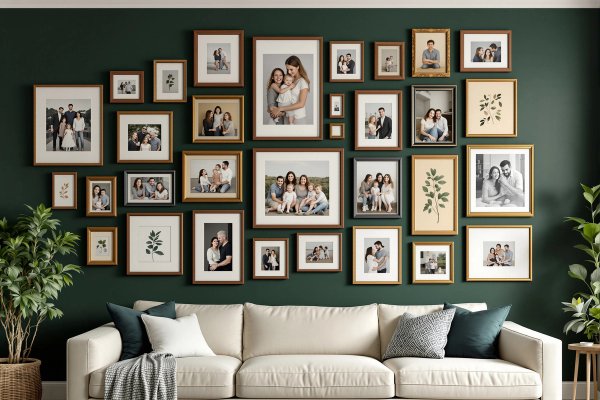
This is a legitimate eclectic gallery wall ideas approach — but it only avoids chaos if one rule is followed. Every frame can differ in finish (black, brushed gold, raw wood), but the frames must share one invisible structure: an invisible horizontal centerline at 60 inches from the floor.
Place the largest piece first. This should be a 16×20 or 18×24 inch frame. Every other frame orbits it.
Mix art styles confidently — a topographic map next to a black-and-white portrait next to a loose watercolor landscape — because the shared centerline does the visual organizing work.
Use 7–11 frames total. Keep gaps between 2 and 4 inches. Never leave a gap wider than 5 inches or the grouping falls apart into separate pieces.
Price history tracked · tap to check current price on Amazon
 ↑ Price rising
 12 Pcs French Country Prints
↑ At peak — price may drop
Price history · 16 weeks
 ✦ Editor's pick
 Picture Frames Set of 10
Price history · 16 weeks
 ✦ Editor's pick
 Set of Black Picture Frames
Price history · 16 weeks
Entryway and Hallway Gallery Wall Layouts Built Around How People Move
An entryway or hallway gallery wall is viewed differently from every other wall in your home. People move past it at walking pace. They never stand directly in front of it. That changes everything about spacing.
Standard gallery wall advice was written for rooms people stand in. It doesn't translate here without adjustment.
The Narrow Hallway Walk-Through Gallery: Spacing Specs for a Corridor

In a hallway under 48 inches wide, frames should be viewed from 24–36 inches away at most. At that distance, fine detail reads well but large clusters blur together.
Use 5–7 frames in a single horizontal row. Frame sizes should stay in a tight range: 5×7 and 8×10 inches only. Mixing in larger frames makes the corridor feel blocked.
Eye-level anchoring matters more here than anywhere else — hang the center of every frame at exactly 58 inches from the floor, which matches eye level for most adults in motion.
Keep horizontal gaps between frames at 1.5–2 inches. That tighter spacing reads as a gallery strip, not a random scatter. Run the arrangement along one wall only in corridors under 48 inches wide.
The No-Nail Entryway Gallery Wall for Renters

This layout is built entirely around one constraint: zero wall damage at move-out. Every frame must hang using adhesive-based hanging strips rated by weight capacity.
Check the weight of each frame before you buy the hanging hardware. Most adhesive strips cap out at 4–7 lbs per pair. A frame with glass and a heavy moulding can easily hit 3–4 lbs before any art is inside it.
Limit frame sizes to 8×10 inches or smaller, and stick to lightweight materials like thin wood or plastic moulding, to keep each frame well under the adhesive weight limit.
Use 6–8 frames arranged in two staggered rows. Stagger the second row 3 inches left or right of the first so gaps don't align. This breaks the grid pattern and suits the informal entryway setting.
Bedroom Gallery Wall Designs for Two Very Different Wall Situations
The bedroom presents two completely different gallery wall problems. One is the wide open wall above the bed — a lot of space with soft safety requirements. The other is the narrow leftover strip beside a closet or dresser. Both need different logic.
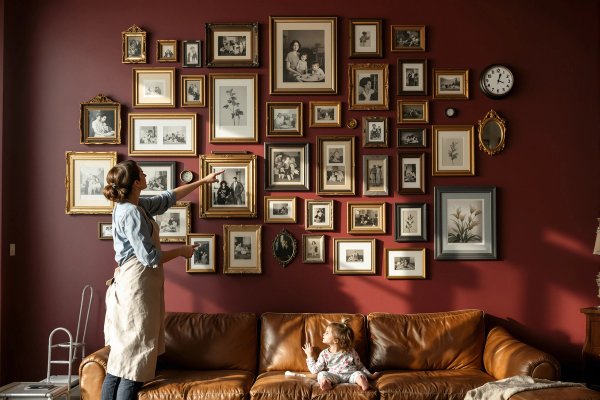
Vintage-Inspired Gallery Wall Ideas Above the Bed: Maps, Mirrors, and Frames

Above bed decor has one non-negotiable rule: nothing heavy hangs where it could fall on a sleeping person. That means no frames over 5 lbs and no glass heavier than 2mm hanging directly over the pillow line.
These vintage-inspired gallery wall ideas work best with a mix of paper-backed prints under acrylic (not glass), small frameless mirrors, and one or two antique-style map prints. Aim for a total of 9–13 pieces across a king-size headboard (76 inches wide).
The bottom edge of the lowest frame should sit at least 12 inches above the top of the headboard — that's the clearance most interior designers recommend for above-the-bed hanging safety.
Use a vintage gallery wall ideas approach with aged gold and dark wood frames mixed together. Keep sizes varied: a mix of 5×5, 5×7, and 8×10 inch frames, with one 10×10 inch map print as the anchor. For inspiration on how professional designers approach bedroom walls, Architectural Digest is a useful reference.
The Narrow-Wall Gallery for Awkward Bedroom Nooks

The strip of wall beside a closet or beside a freestanding dresser is usually 12–24 inches wide. Most people ignore it. A vertical gallery stack makes it functional.
Use 3–5 frames stacked in a single vertical column. Sizes should decrease as they go up: 8×10 at the base, 5×7 in the middle, 4×4 or 4×6 at the top. This creates a tapered look that draws the eye upward.
Keep horizontal centering exact — every frame's midpoint should share the same vertical centerline, which you can mark lightly with a pencil before hanging.
Leave 2–3 inches between each frame vertically. The total stack should span no more than 36–40 inches in height to avoid overwhelming a narrow wall.
Staircase and Corner Gallery Walls: The Layouts With the Trickiest Geometry
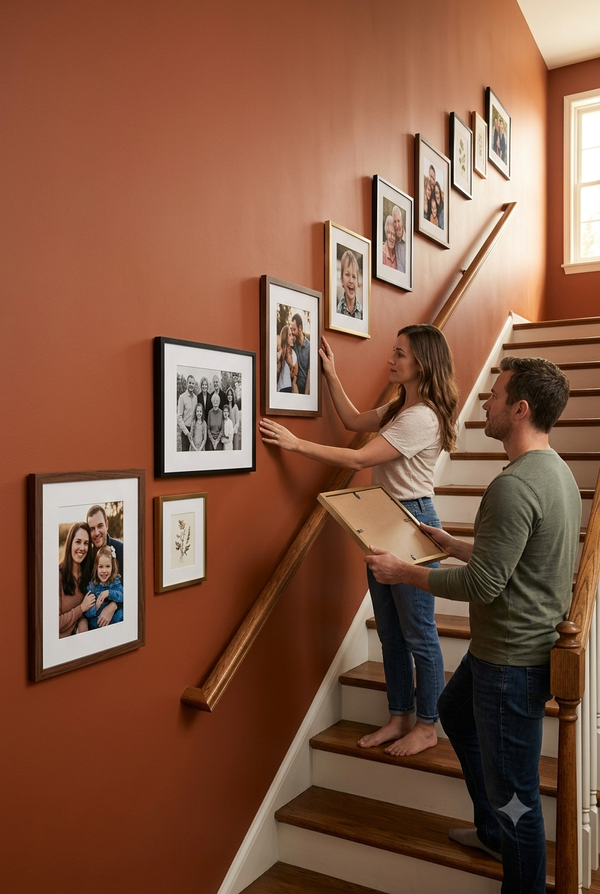
Staircases and corners break the rules of every standard gallery wall guide. The floor isn't level. The wall isn't flat in one plane. You need layout logic that accounts for angles and seams before you put a single nail in.
The Diagonal Staircase Gallery: How to Follow the Stair Angle With Mixed Sizes

The key to a staircase gallery is the pitch. Most residential staircases run at a 35–40 degree angle. Your frame arrangement should follow that same diagonal line — not hang at a level horizontal.
Use 2 oversized landscape-format frames (16×20 or 18×24 inches) as anchors. Space them along the staircase at intervals of roughly 3 stair-rises apart. Fill the gaps between them with 3–5 smaller square frames (6×6 or 8×8 inches).
The diagonal centerline of the full arrangement should run parallel to the stair pitch — if you held a ruler along the midpoints of all frames, it should tilt at the same angle as the handrail.
Hang each frame so its own horizontal center is level, even though the arrangement overall is diagonal. Mix frame finishes — black with natural wood — to match the casual, layered feel of a staircase setting.
Corner Photo Gallery Wall: Frames That Actually Turn the Corner

Most people stop their gallery at the corner. This corner photo gallery wall layout doesn't. Frames wrap the wall seam and continue onto the adjacent wall — which requires specific sizing logic near the corner itself.
On the main wall, run your gallery normally until the last frame sits 4–6 inches from the corner. On the adjoining wall, start with a small frame (4×6 or 5×7 inches) positioned 3–4 inches from the corner seam. This creates visual continuity without crowding the junction.
Size down by at least one step as you approach the corner on both sides — if your main wall uses 8×10 frames, the two frames flanking the seam should be 5×7 or smaller.
The math: on each wall, the last frame's outer edge should be no closer than 3 inches to the corner. That 3-inch buffer on both sides keeps the seam readable and prevents frames from visually colliding. Use matching frame finishes on both walls to reinforce that the arrangement is intentional, not accidental.
Kitchen and Dining Gallery Walls Built for Real Household Conditions
Kitchens and dining rooms are high-traffic, high-humidity, high-mess environments. Gallery walls here need to be practical first, decorative second. That means easy cleaning, easy swapping, and nothing too precious on the walls.
The Budget Mismatched-Frame Eclectic Gallery Wall: One Finish, Any Print

This eclectic gallery wall ideas approach is built around one trick: thrifted or mismatched frames unified by a single spray-painted finish. Every frame gets painted the same matte gold (or matte black, or flat white). The frames themselves can be any shape or original color.
This makes a $5 thrift store frame look intentional next to a $20 box-store frame. The prints inside can be completely random — food illustrations, botanical prints, a child's drawing — because the unified finish carries the cohesion.
Budget for $15–$40 on a can of spray paint rated for wood and metal, and it will cover 8–12 frames — making this the lowest-cost gallery wall approach in this entire guide.
Use 7–10 frames in a loose arrangement. Leave gaps between 2–4 inches. Because kitchens collect grease and dust, choose frames without intricate carved details that are hard to wipe down.
The Fun Rotating Kids'-Art Gallery: Swap-Friendly and Low Maintenance

This is a fun gallery wall built for one constraint: the art inside it changes every few weeks. Permanent mounting defeats the purpose. The display system has to allow fast swaps with no tools.
Use clip-style frames or front-opening frames without backing screws. These open from the front with a simple latch. A child can swap the art themselves without removing the frame from the wall.
Mount 6–8 frames in two rows at adult hip height — roughly 36–40 inches from the floor to frame center — so children can see their work and adults can swap pieces without crouching.
Keep all frames the same size (8×10 or A4) so any piece of art fits without trimming. Label each frame lightly on the back with a child's name if you have multiple kids. This keeps the rotation organized and the wall looking consistent.
If you enjoy making display pieces yourself, DIY Halloween Decor: 13 Handmade Styling Ideas That Look Surprisingly Elevated covers similar low-cost, high-impact techniques worth adapting.
Frequently Asked Questions
How many frames do I need for a gallery wall? Most gallery walls work best with 5–13 frames depending on wall size. A sofa-width grid needs 9. A hallway strip needs 5–7. A staircase needs 5–9. More than 15 frames usually starts to feel cluttered unless the wall is very large.
What is the correct spacing between gallery wall frames? The standard is 2–3 inches between frames for a tight, cohesive look. Hallway galleries work better at 1.5–2 inches because of the narrow viewing distance. Eclectic living room layouts can stretch to 4 inches max before the grouping starts to break apart.
Can you do a gallery wall without damaging the walls? Yes — with conditions. Frames must be lightweight (under 4–5 lbs each), sized at 8×10 inches or smaller, and hung using adhesive strips rated for the specific frame weight. Heavier frames or larger sizes need nails regardless of the product's marketing claims.
Every room in this guide now has a real, buildable picture gallery wall design with the actual numbers — not just a mood board to copy. Save or pin this guide before you buy a single frame. Unique wall decor starts with a plan, and now you have one.
Comments